March 4, 2026
Introducing the Marketing Orchestration Engine: Bringing Harmony to Workflow Complexity

Vishal Sood
Founding Member & President, R&D
Typeface has crossed a new frontier, evolving into the next generation of the Typeface Orchestration Engine — closing marketing's open loop by bringing brand context, AI agents, and real campaign performance into one system. Marketing, IT, and Creative teams now operate from the same foundation across the entire marketing lifecycle. Register now for a live webinar to see what's new.
When we published the first Typeface Signal Report last fall, we discovered that 82% of AI efforts remain stuck in experimentation, blocked by execution, compliance, data, and governance hurdles.
But here's what we kept hearing from customers: the thing holding marketing teams back isn't the technology.
Instead, it's that the three teams responsible for marketing outcomes (Marketing, IT, and Creative) are all working toward the same goal from different corners of the organization. However, each of these groups is more internally fragmented than expected.
Marketing alone might include brand, demand generation, product marketing, field marketing, and content, each with their own priorities and tools. Marketing channels are similarly siloed and require different tools and skills, from email to web to social.
IT and Ops include marketing operations, data engineering, security, and platform administrators.
Creative spans in-house designers, agencies, freelancers, and production teams.
So, it's not really three teams. It's dozens, with different tools, different workflows, and no shared operating system tying it all together.
That fragmentation creates a ceiling. Too many manual handoffs, too much inconsistency, and governance gaps that make it hard to scale anything reliably. We've seen this pattern across enough Fortune 500 organizations now to believe it's structural, not situational. Enterprises don’t need another AI content tool; they need a platform where all three teams can work from the same foundation, and where AI can run end-to-end workflows, not isolated tasks.
That's what we've spent the past year building. Today, we're announcing Typeface's evolution into a Marketing Orchestration Engine.
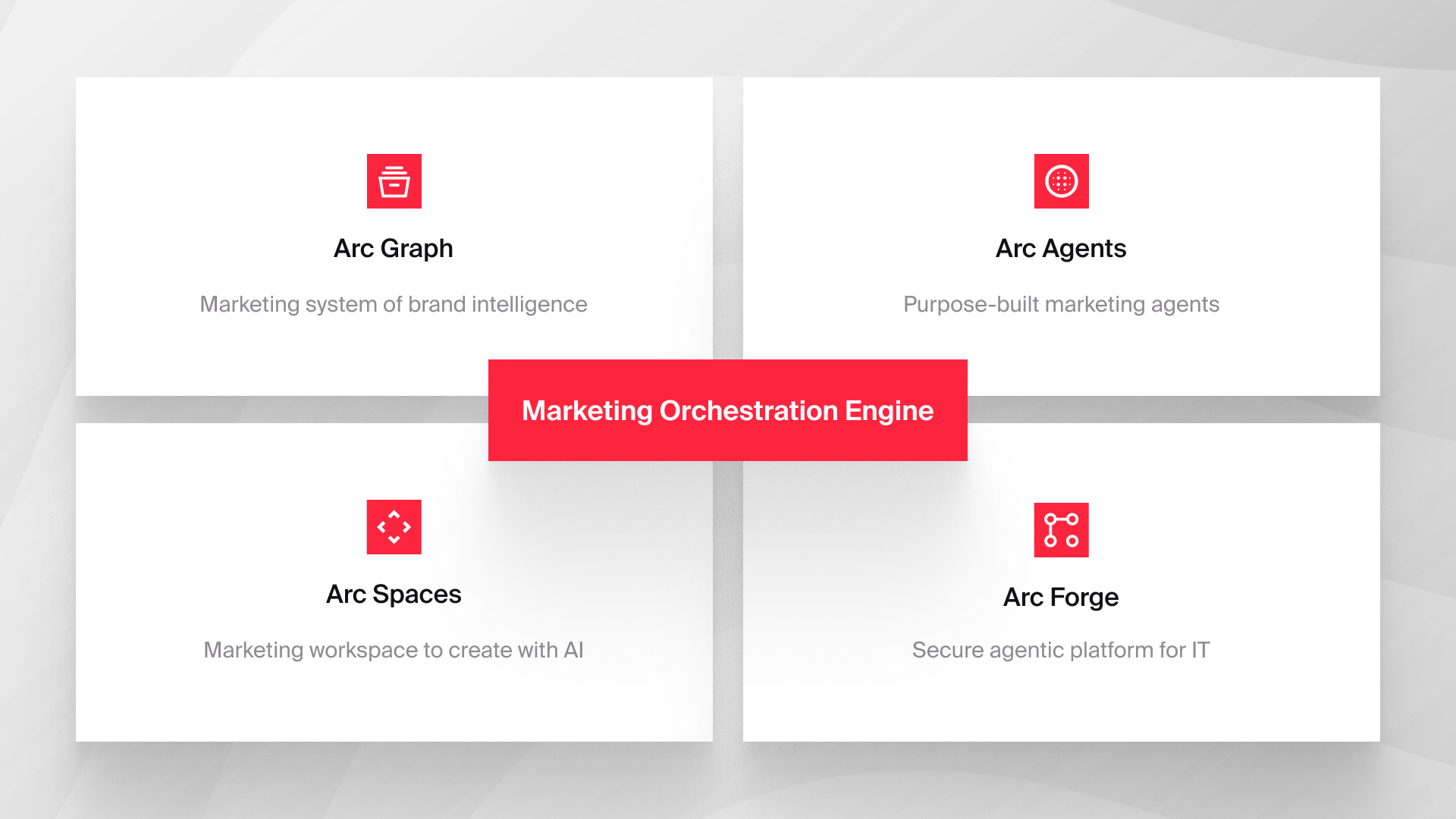
What we mean by "Marketing Orchestration Engine"
We want to be precise about this, because "orchestration" has become one of those words that means everything and nothing.
What we mean: Typeface now unifies the workflows of Marketing, IT, and Creative teams on a single platform, powering the full content lifecycle from strategy through creation to activation. Marketing gets an end-to-end, cross-channel view of their entire marketing lifecycle, along with consistent outputs grounded in deep brand intelligence: voice, visual identity, and strategic positioning. IT can build and deploy marketing agents that turn workflows into repeatable systems. Creative teams can connect their preferred tools so that orchestration happens in one place, not scattered across a dozen point solutions.
As we expand across retailers, our goal is to create accurate, brand-compliant product content quickly and at scale. Typeface enables us to convert product data into retailer‑ready content automatically — streamlining formatting and incorporating approved language to ensure brand and compliance accuracy. With this automation, our team can deliver content to retailers faster, while improving consistency and performance across Post’s digital shelf channels.
- Cristina Eggum, Senior Manager, Digital Shelf at Post Consumer Brands
Today, we’re introducing Arc, an expanded product portfolio with new capabilities to help enterprises manage the full arc of the content lifecycle. From strategy and creation to activation and continuous optimization, Arc unifies every stage into a single, connected system.
The platform is built on five core ideas:
1. Arc Graph: Brand intelligence that actually compounds
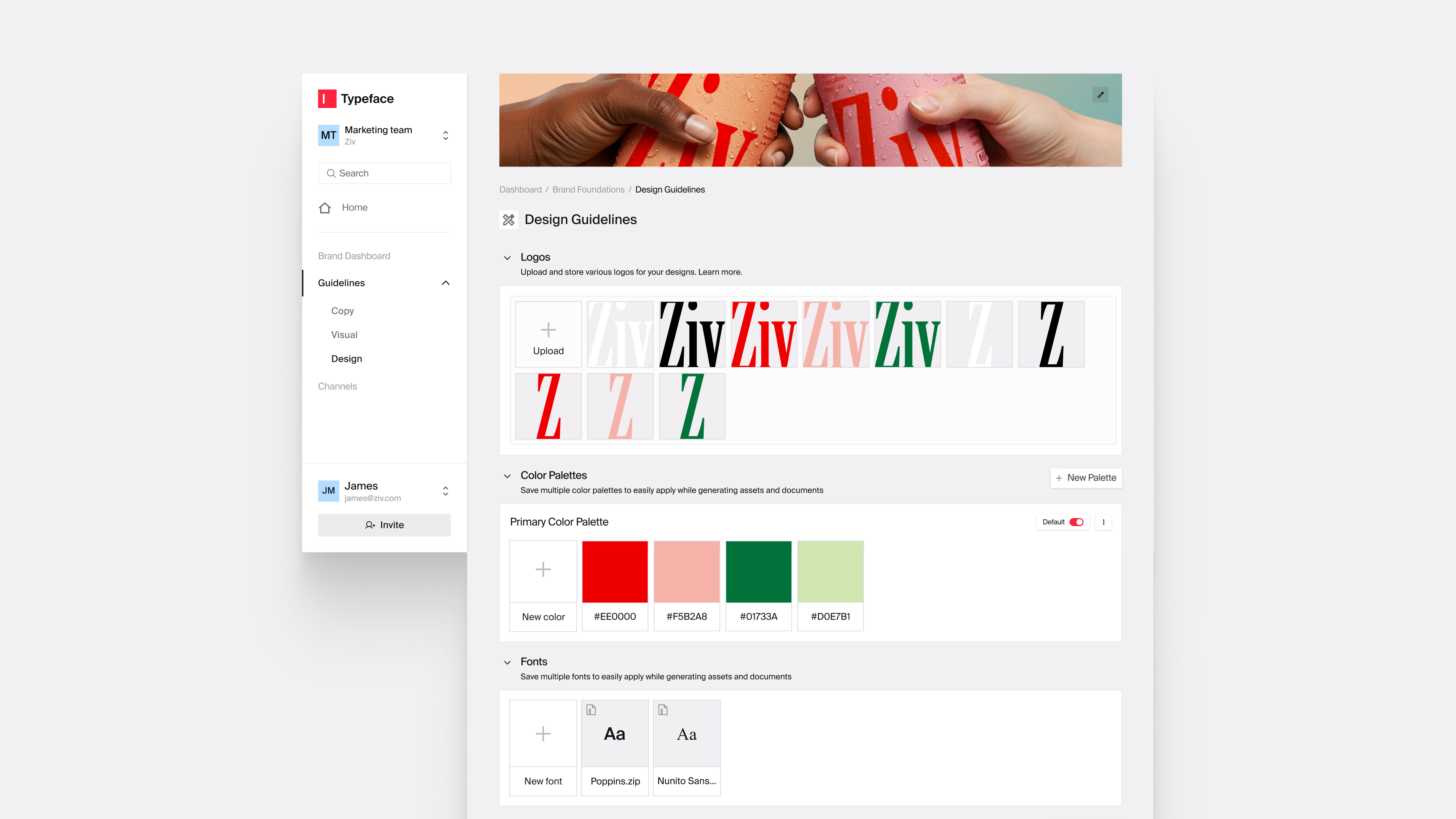
Scaling content means nothing if it's generic. Just as LLMs have transformed developer productivity by embedding deep, always-on context into workflows, the same paradigm shift is coming to marketing.
At the core of Typeface is Arc Graph, a unified brand and knowledge intelligence layer that brings together brand standards, approved assets, audience data, layouts, channel requirements, and performance signals into a single system. The key word is living — it continuously evolves as your brand and campaigns do, so agents always work from the most current foundation.
Our agents use this context to generate, evaluate, and refine brand-aware outputs, surface recommendations, and keep campaigns aligned as they scale across channels, teams, and regions.
This is the piece most AI content tools skip entirely. They treat brand context as a one-time upload. We treat it as infrastructure.
2. Arc Agents: Purpose-built agents that handle the complexity marketers shouldn't have to
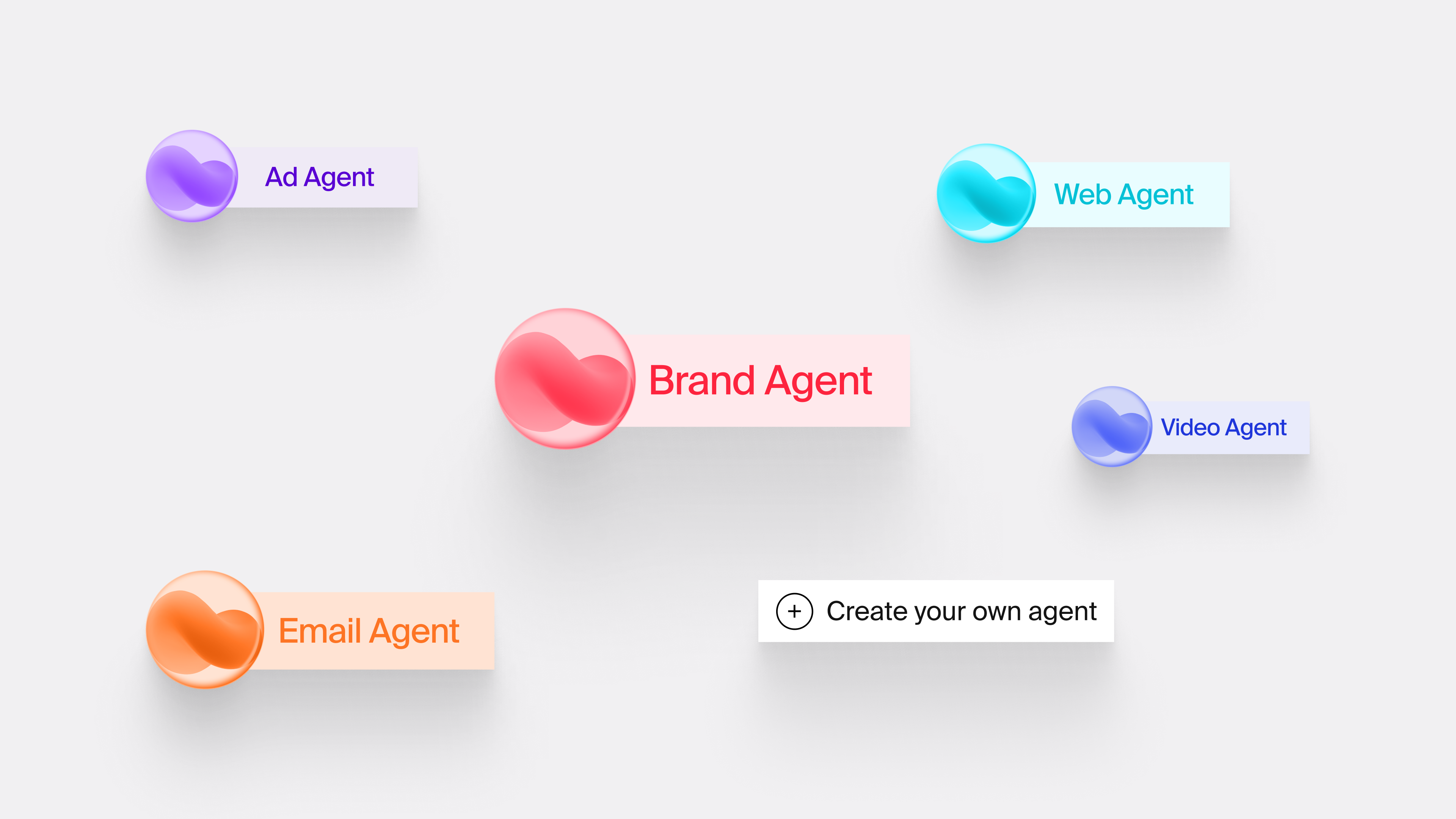
Marketing requires orchestrating hundreds of tasks across channels. Arc Agents are specialized marketing agents that handle that complexity, so teams can focus on strategy and creative judgment.
Marketers can transform briefs into complete campaigns, tailor personalized variations across audiences, and create content across email, ads, social, web, and video:
The Email Agent designs personalized journeys from ABM to multi-step sequences.
The Ad Agent optimizes creatives across platforms with format-specific variations.
The Web Agent builds conversion-focused content with SEO optimization and competitive insights.
The Video Agent transforms transcript-based videos (webinars, interviews, and keynotes) into short-form sizzle reels with generated title cards and transitions, ready for social, internal, or community channels.
3. Arc Spaces: Where teams work
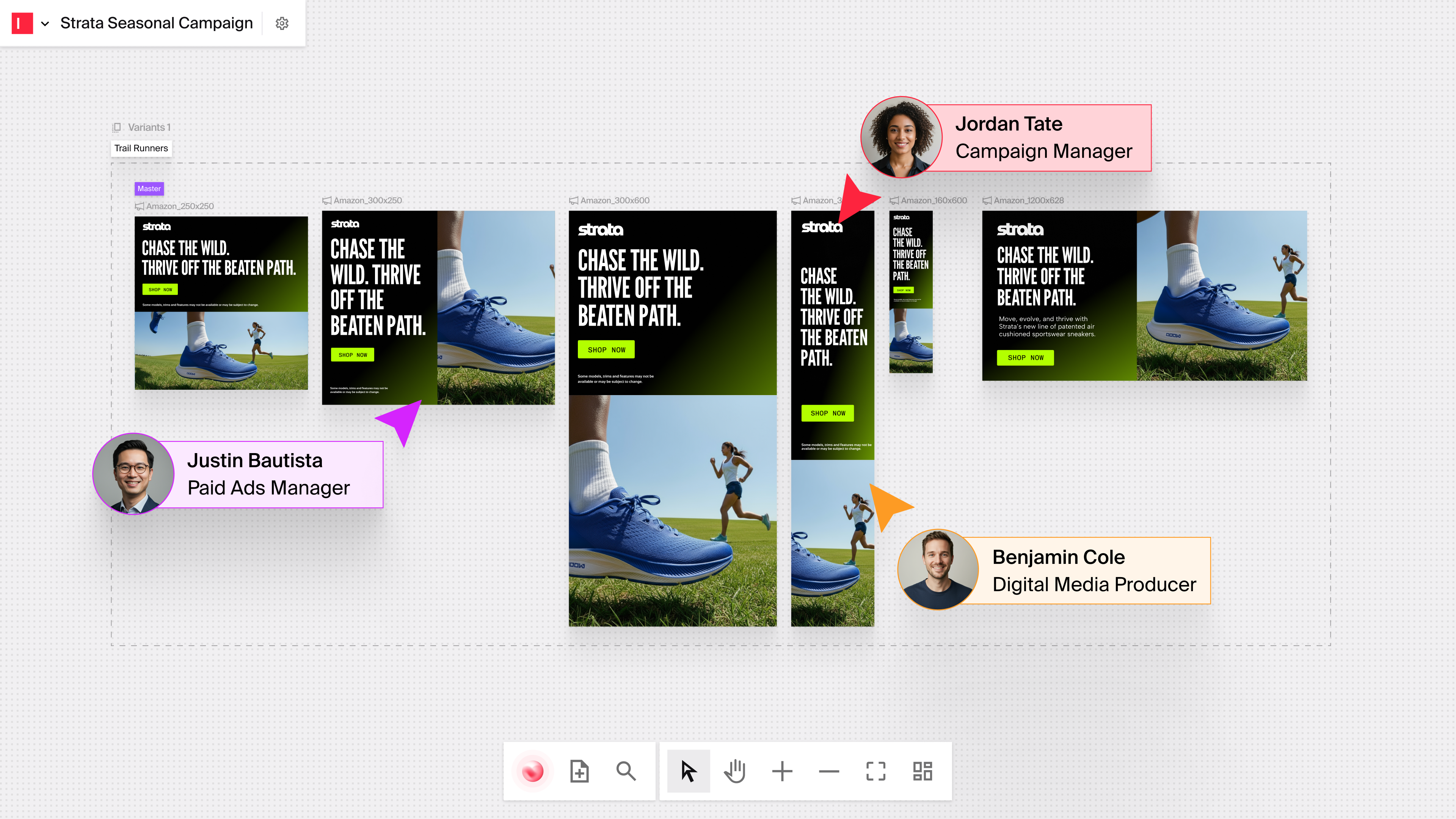
The biggest source of friction we hear from customers is lack of coordination, not content quality. Managing a campaign across tools, channels, and team members creates overhead that slows everything down.
Arc Spaces helps solve this core problem. Arc Spaces is a visual canvas where marketers and AI agents collaborate, so teams can see their entire campaign in one view. Marketers get instant visual previews without depending on engineering to edit HTML. Personalized variations and A/B tests sit side by side for easy comparison. Content lifecycle workflows (status updates, approvals, notifications) are built right into where teams create.
Arc Spaces also includes semantic search across text, images, and video in your content library using natural language (no manual tagging), and connectors that let teams send approved content directly to publish platforms.
4. Arc Fabric: IT-powered architecture for marketing at scale
Here's a pattern we keep seeing: every enterprise has a few AI power users who know the right prompts and workflows. But that know-how doesn't scale. It lives in someone's head, or in a Slack thread, or in a doc no one reads.
The cross-team nature of these workflows, paired with our deep enterprise experience, led us to deliver an IT-focused capability in Arc Fabric.
Arc Fabric lets teams codify how work gets done into structured, customizable agents, so quality becomes repeatable and execution scales across teams and regions. With Agent Studio, builders assemble steps into a single orchestrated workflow, then publish it as an agent for the rest of the organization to use. Each step can include its own instructions, logic, and integrations. With built-in governance, IT teams can safely manage and integrate agents while marketing teams use and iterate on them through a marketer-friendly interface.
Critically, teams don't need to change how they work. They can deploy agents into existing infrastructure via Typeface MCP (Model Context Protocol), APIs, webhooks, or custom code, or run them directly in MCP-compatible clients. Agents pull approved brand and campaign context into whatever tool teams are already using.
5. Arc Loop: Our future vision of the content flywheel
Here's where we think the industry is headed, and where we're placing our biggest bet.
Most AI marketing tools today are open-loop: they generate content, teams publish it, and then... that's it. The performance data lives somewhere else. The insights don't flow back. Every campaign starts from scratch.
We think that model is fundamentally broken. The unlock is a system where every piece of content generated teaches you something about the audience it was meant for, and every audience signal you capture improves the next piece of content. A flywheel, not a factory.
That's what we're building with Arc Loop: a closed-loop system where performance and engagement signals feed directly back into how agents plan, create, and operate. Content performance data flows back into Arc Graph, enriching the brand intelligence and audience understanding that powers the next campaign. Marketers set direction. IT governs how that learning is applied. And the system gets smarter with use, creating compounding value that can't be replicated without the same data and usage history.
Concretely, this means the content Typeface generates for a micro-segment in Q3 will be measurably better than what it generated in Q2, because the system learned from what worked. Over time, teams move up the personalization ladder, from broad segments to persona-level micro-segments to true 1:1 content, as the flywheel accumulates signal.
Typeface goes beyond task execution. It will get measurably better at it with every campaign that runs. That's the defensible moat we're building, for us and for our customers.
Orchestration is more than a platform
We also recognize that orchestration isn't "set it and forget it." The biggest barrier to scaling AI is operational readiness.
That's why Typeface combines the platform with delivery support and partner-led services. Teams work alongside AI experts to drive adoption, refine agents, validate results, and operationalize change, moving from pilots to repeatable production deployments with measurable gains in brand adherence, compliance, and performance.
What we're seeing with customers today
These aren't hypotheticals. Here are four patterns we're seeing with Fortune 500 organizations that have moved past experimentation into production:
Product content that ships in hours, not weeks
Commerce teams live in a world of constant updates: new SKUs, seasonal drops, channel-specific formatting. One of our retail customers built a product description agent that generates consistent, compliant descriptions at scale across channels. Teams upload an image, specs, or product lists and get platform-ready variants instantly, without drifting off-brand or missing approved claims. Teams can now accomplish in minutes what once took days.
Quality assurance that scales with volume
As output grows, reviews become bottlenecks. One of our CPG customers uses Arc Graph as the connective tissue: content is automatically evaluated against brand rules, recommendations surface proactively, and campaigns stay aligned as they scale. As a result, quality becomes consistent across creators and tools, with issues flagged early instead of caught in late-stage cycles.
ABM personalization that doesn't break governance
Everyone agrees personalization works, until they try to scale it across hundreds of accounts and segments. That's when teams hit a wall: manual research, inconsistent messaging, and governance risks. With agent workflows, teams personalize by buying stage, persona, or segment while keeping messaging consistent across regions and channels. Email, landing pages, ads, nurture sequences, all aligned with brand voice, all within governed workflows that IT can audit.
Multi-channel campaigns that launch in days, not months
Several Fortune 500 financial services organizations are building custom campaign agents that codify personalization into repeatable, brand- and policy-intelligent systems. Teams research customer needs, identify the right products, and launch workflows that generate channel-ready copy for paid ads, web pages, and email sequences, along with audience-specific variants by segment.
The bigger picture
What we keep coming back to is this: the barrier to scaling AI in marketing isn't better models. It's operational readiness. It's getting Marketing, IT, and Creative to work from the same system with shared governance, shared context, and shared accountability for outcomes.
That's what the Marketing Orchestration Engine is designed to solve. And we're just getting started.
Save your spot now for our live webinar to see what this could look like for your organization, or reach out to your Engagement Manager. We'd love to hear what you're working on.
Related articles
September 22, 2026
Arc Graph, Arc Fabric, and Arc Loop are the three products behind the next generation of the Typeface Orchestration Engine, built to turn brand intelligence into shipped work, then feed the results ba
March 4, 2026
Marketing leaders understand AI's potential. They've run pilots, seen the results, and watched their teams get excited about what's possible. Then, they walk into the budget meeting, and that’s where

January 27, 2026
You could invest in the best AI marketing tool for your team, but it’s how they work with it that decides success. The teams that get the most from AI — what we’re calling high-performing AI marketing