June 17, 2026
Content Quality Control in AI Marketing: Enterprise Governance and Best Practices for Brand Integrity

Mohit Kalra
Chief Information Security Officer

AI summary
Effective AI adoption requires clear quality standards, review processes, and guardrails to ensure content aligns with brand voice and compliance needs. This blog explains how enterprises can implement governance and best practices to keep AI-generated content reliable and on-brand.
From our conversations with clients exploring AI for marketing, two requirements consistently emerge.
First, brand assets are non-negotiable — product imagery, company logos, and color palettes must be preserved exactly as specified. When your signature azure blue looks washed out across hundreds of assets, you’re staring at major rework or a post-campaign firefight. Brands want consistency at any scale.
Second, enterprises need systems that apply curated rules via AI when generating new content around these protected elements. They also prefer taking preemptive measures to avoid potential violations of brand and industry standards. Not only should AI agents enter production fluent in your brand, but also assess their own outputs in real time to catch any violations before they ship.
This article shows you exactly how to do that, from setting up brand guidelines your AI can actually follow, to implementing approval workflows that catch issues before they go live.
Let’s start with the basics.
Why do you need governance for AI marketing?
Governance gives you the controls to ensure every piece of AI content matches your brand standards before it reaches your audience.
Here's what good governance does:
Protects your brand reputation
AI applies your image styles to new designs or works with your existing templates to preserve visual elements. Trained in your brand voice, it generates content that sounds like you. Because your brand standards anchor every AI output, you'll see fewer brand guideline violations than with ad-hoc AI usage.
Catches compliance issues early
Built-in checks flag potential regulatory problems before content goes live. This matters especially in regulated industries like healthcare, finance, and legal services where violations carry penalties and erode public trust.
Governance frameworks can typically catch:
Unauthorized claims
Misleading statements
Privacy policy violations
Industry-specific regulatory issues
Speeds up approvals, doesn't slow them down
Clear quality standards mean reviewers spend less time checking basics (is this on-brand?) and more time on strategy. Most teams might see 40-60% faster approval cycles once governance is properly implemented.
Before governance:
5-7 revision rounds typical
7-10 day approval cycles
Approvers checking basic brand compliance manually
After governance:
2-3 revision rounds
2-4 day approval cycles
Approvers focusing on messaging strategy and positioning
Frees up your team for higher-value work
When AI handles routine content creation with built-in quality controls, your marketers can focus on strategy rather than fixing inconsistent messaging.
Your team's time shifts from:
Creating first drafts → Refining AI outputs and strategic planning
Checking brand compliance → Developing new campaigns
Fixing consistency errors → Analyzing performance and optimization
Builds confidence in AI tools
Stakeholders trust AI more when they can see the quality controls in place. This leads to wider adoption and better ROI on your AI marketing investment.
Legal teams, executives, and brand managers feel comfortable with AI when they understand:
What guardrails exist
How violations are prevented
Who reviews what content
How the system learns and improves
What effective AI marketing governance looks like (hint: it’s not a checklist)
Ticking off brand rules on a checklist adds a speed tax and breaks down when AI adoption grows. Effective AI marketing governance centralizes brand intelligence and embeds brand guidelines directly into workflows. It becomes the infrastructure that enforces standards and audits automatically — working for your teams, not against them.
Feature | Checklists for AI marketing governance | Governance as infrastructure |
What is it? | A guide for checking AI content against brand guidelines | Brand guidelines are encoded in workflows and centralized in one system that every workflow pulls from |
How does it work? | Teams refer to a checklist to spot and fix deviations from brand standards | Guidelines are automatically applied to content and violations flagged in real-time |
Benefits | Forces human review of every brand guideline | Removes the speed tax of human review |
How to use it | For pilots and small projects; fails at scale | For enterprise campaigns; built for scale |
How does Typeface ensure content quality in enterprise marketing?
Typeface keeps enterprise content accurate and on-brand through a purpose-built quality assurance system. It treats content governance as infrastructure that underpins the full campaign lifecycle.
Typeface’s quality assurance system
Brand and audience alignment: Your guidelines, tone specifications, and audience personas integrate directly into the AI's generation process
Multi-layered content validation: Automated checks combined with human-in-the-loop oversight catch issues at multiple stages
Intelligent feedback loops: The system learns from campaign performance and user feedback, automatically adjusting future content parameters
Here’s a closer look at how each works in the Typeface platform.
How does Typeface keep your brand consistent across all AI-generated content?
Arc Graph, Typeface’s centralized system of intelligence for your brand, automatically applies your guidelines to every piece of content the AI creates. It’s a brand hub, turning passive PDFs and DAMs into an active governance system that guides how you build and improve campaigns.
What is a brand hub in AI marketing?
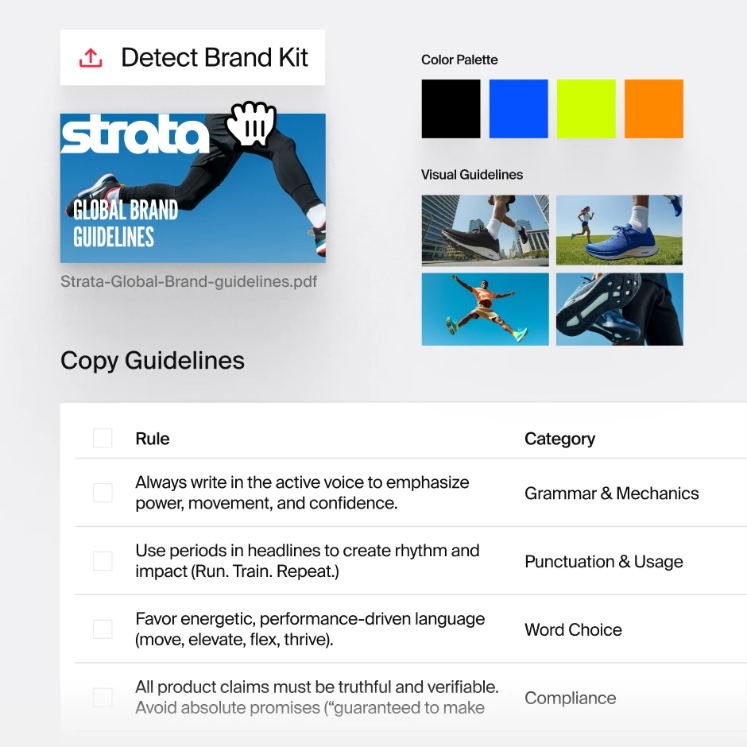
A brand hub is your central repository for everything that defines your brand: logos, colors, fonts, voice guidelines, compliance rules, and approved templates. Think of it as your brand's instruction manual that AI systems can read and follow.
If Arc Graph is your brand intelligence engine, Brand Kits put it to work. They fold your brand elements and audience attributes into content, so that your blog reflects your voice and your emails speak to their recipients.
Create as many Brand Kits as you need, each with its own inputs and guidelines scoped to a specific project. Clients use them to manage global brands alongside sub-brands, keeping every output consistent without sacrificing flexibility. That's granular control over how you create with AI.
It’s also secure. Typeface offers a comprehensive enterprise security framework that gives Fortune 500 companies confidence to expand AI usage across the enterprise.
Setting up your Brand Kit
Your Arc Graph transforms your existing guidelines into dynamic Brand Kits. This goes far beyond basic brand management, to include:
Visual identity elements:
Logos (all approved versions and usage rules)
Color palettes (with specific hex codes and usage contexts)
Typography (approved fonts and hierarchy rules)
Design layouts and templates
Image style guidelines
Voice and messaging:
Text style guides (brand values, tone, personality)
Voice training for different contexts (social media, white papers, ads)
Words and phrases to use or avoid
Punctuation and formatting preferences
Default language and regional variations
Compliance and legal:
Industry-specific requirements
Legal disclaimers and required language
Regional regulatory guidelines
Pro Tip
Pro Tip
To ensure the best quality, train the AI with long-form content where possible. The ideal amount is 15,000 words or more on various topics, so the AI has enough to work with even after cleaning the data you provide. For short-form content like ads or social posts, share at least 10 examples to get good results.
Training AI on your image style
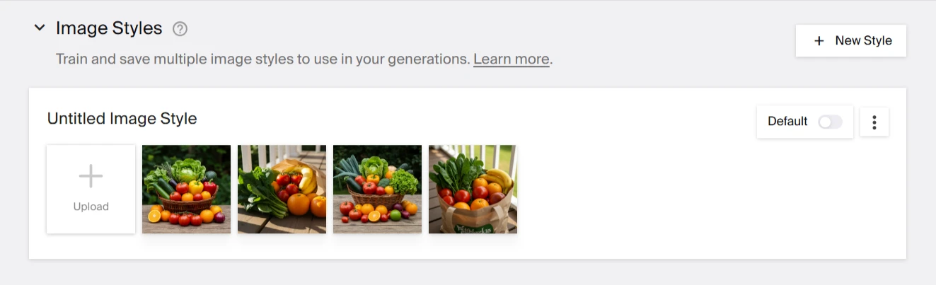
You can upload multiple images that represent your desired visual style. The AI learns from these examples and replicates the look when generating new images.
For example, if your brand uses:
Bright, high-contrast photography
Minimalist product shots on white backgrounds
Lifestyle imagery with specific color grading
Upload 10-15 examples of each style. The AI will analyze composition, lighting, color treatment, and subject matter to generate images that match.
You can save different image styles and choose which to apply to specific campaigns. For instance:
"Product launch style" for new product announcements
"Lifestyle images" for social media
"Corporate style" for B2B materials
Training AI on your brand voice
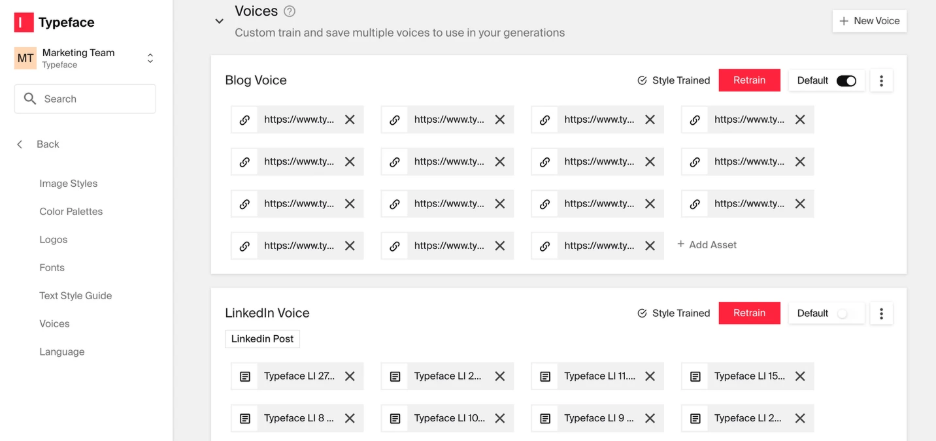
To generate content that accurately mimics your brand's voice, upload existing content samples. You can train and save multiple voices for different purposes:
CEO voice for thought leadership and company announcements
PR voice for news articles and press releases
Support voice for customer communications
Social voice for casual platform engagement
If your company has multiple products or sub-brands with different brand guidelines, set up separate Brand Kits for each. You can switch between Brand Kits in settings when generating content for different brands.
Setting brand rules
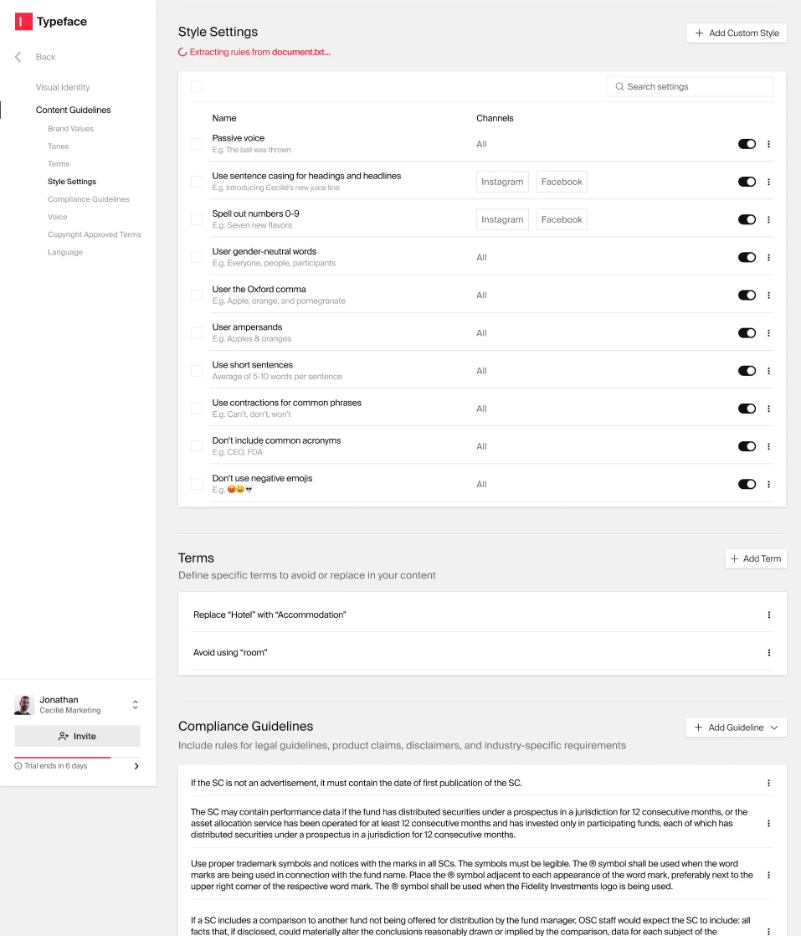
The Brand Kit's rules engine applies guidelines automatically to all generated content. You can set rules for:
Formatting: Heading styles, bullet point usage, sentence length
Language: Inclusive language requirements, terminology preferences
Brand-specific rules: Always capitalize product names, never use certain phrases
Regional guidelines: UK vs. US spelling, market-specific messaging
Legal requirements: Required disclaimers, claim substantiation
Our AI ensures these rules are met across all generations; not as a post-generation check but built into the process itself.
Pro Tip
Pro Tip
When defining prohibited phrases, include the reason why. This helps the AI understand context. Instead of just "avoid: cutting-edge," use "avoid: cutting-edge (overused buzzword, use specific benefit instead)."
How do you create personalized content for different audiences with AI?
You can do this by setting up audience segments in Arc Graph. Define who each audience is and what drives them. The AI then tailors content to resonate with the specific audience.
Setting up audience intelligence
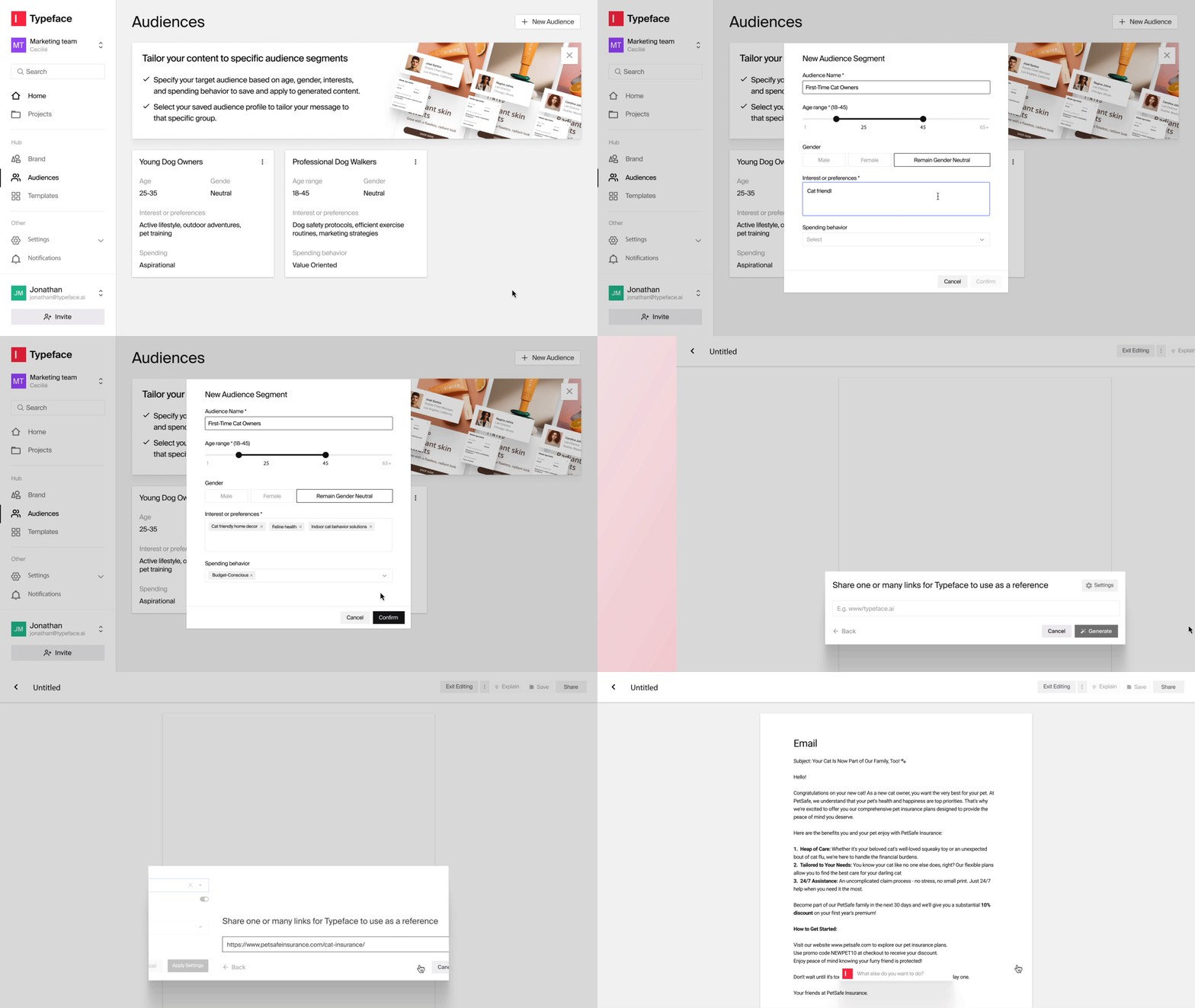
Typeface's Audiences feature lets you create and save multiple audience segments, either manually or by importing from your Customer Data Platform (CDP).
Manual audience setup includes:
Age and gender demographics
Spending behavior and purchase patterns
Interests and motivations
Pro Tip
Pro Tip
When defining your audiences' interests or preferences, be as descriptive as possible. Instead of simply adding "dog lovers," use "dog lovers interested in outdoor adventure and an active lifestyle with their pets." The more specific you are, the better the AI can tailor messaging.
Importing audience data from your CDP
Typeface integrates seamlessly with major Customer Data Platforms. Once connected, the platform automatically:
Imports all your audience segments
Creates summaries of each persona
Updates as your CDP data changes
Your AI content stays aligned with your actual customer data, not outdated assumptions about who your audience is.
How can you tell if AI-generated content will actually perform?
Remember, AI is great at analyzing content, including what it created and how it got there. This is explainable AI at work building transparency and a feedback loop that improves what gets made.
What Is Explainability in AI Marketing?
Explainability means understanding why the AI made specific content decisions and whether those decisions are likely to achieve your goals. It’s seeing how AI reasoned through a task with the given goal, audience, and assets. That’s the difference between a black box that just outputs content and a transparent system that shows its workings.
Tracing AI’s outputs is one thing. Verifying its quality is another. Explainable AI makes it easier by analyzing content and answering questions like:
Will this content resonate with my target audience?
Does it properly reflect my brand guidelines?
Is it aligned to the channel I'm using?
What specific changes would improve performance?
According to one Forbes Technology Council post, explainability is one of the top AI concerns among marketers and business leaders. AI marketing platforms (including Typeface) are addressing the fear by making AI’s logic transparent.
How Typeface's Explainable AI works
For all AI-generated content, an "Explain" button appears at the top of each document. Click it to access:
1. Improvement suggestions
Specific, actionable recommendations to enhance content alignment with your audience and campaign objectives.
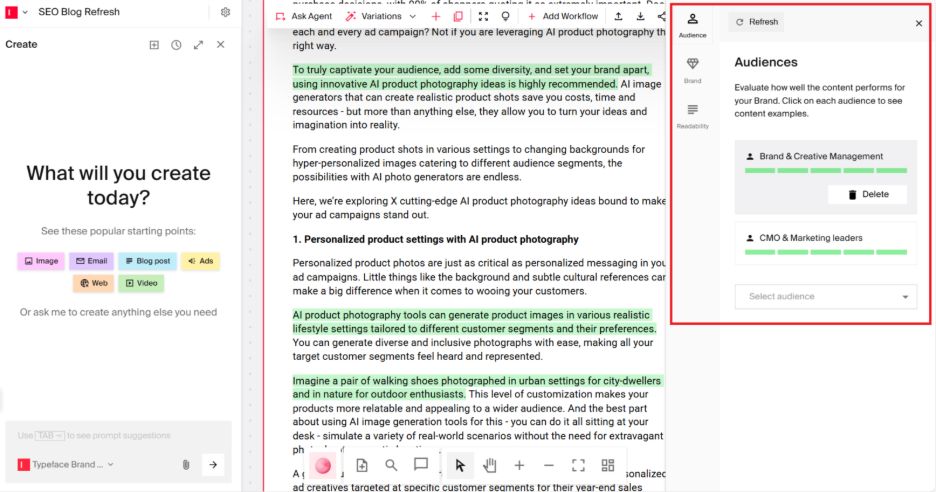
2. Audience analysis
Understand exactly how well your content resonates with chosen audience segments. You can add multiple audiences to this panel to see if the content would work for different segments. Useful when deciding whether to create variations or use one piece across segments.
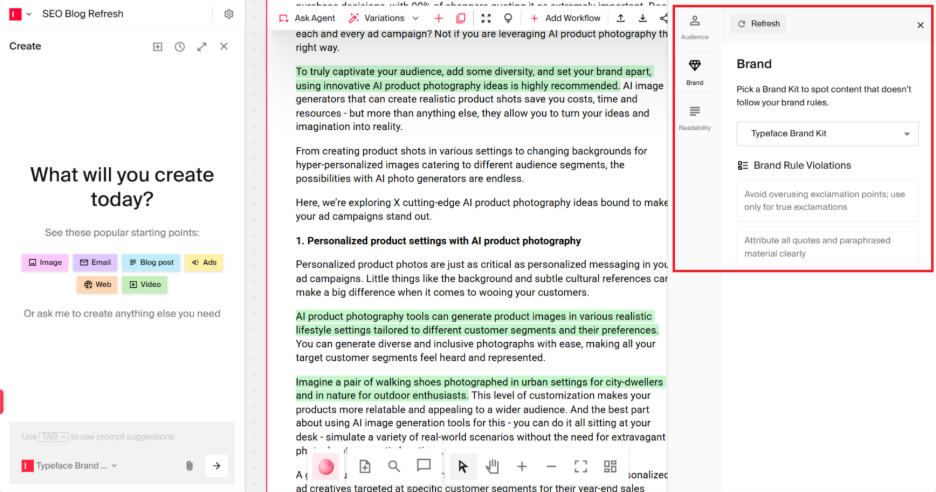
3. Brand compliance verification
Verify that content adheres to your established brand guidelines and voice parameters. You can easily switch between different Brand Kits to evaluate content against multiple brand standards (helpful if you're considering repurposing content for a different brand or region).
How do you prevent AI from creating harmful or non-compliant content?
Multi-layered responsible AI frameworks filter inappropriate prompts before generation and validate content after creation. They also offer customizable safety settings aligned with your industry requirements.
What is responsible AI in marketing?
Responsible AI means building safeguards that prevent AI systems from generating content that could harm your brand.
These are essential for enterprise marketing where brand reputation and regulatory compliance are non-negotiable.
How Typeface's responsible AI framework works
Our approach combines proactive prevention with reactive validation:
Layer 1: Pre-generation filtering
Advanced AI models analyze prompts before content generation begins, blocking requests that could lead to:
Explicit or inappropriate material
Hateful or discriminatory speech
Violent content
Mental health-sensitive or dangerous content
Potential copyright violations
If a prompt triggers these filters, the system explains why and suggests alternative approaches.
Layer 2: Real-time generation monitoring
As content generates, the system continuously checks against responsible use criteria:
Brand safety guidelines
Compliance requirements
Factual accuracy (for claims that need substantiation)
Regulatory adherence
Layer 3: Post-generation verification
Completed content undergoes comprehensive checks before moving to approval workflows:
Compliance verification
Brand guideline adherence
Customizable safety settings
Responsible AI requirements vary significantly across industries and organizations. A healthcare company has different needs than a consumer goods brand.
Typeface offers customizable safety settings that let you:
Set industry-specific parameters: Configure heightened sensitivity for regulated industries like finance, healthcare, or legal services
Define custom violation categories: Add organization-specific content that should be flagged or blocked
Adjust sensitivity thresholds: Balance between strict filtering (fewer false negatives) and creative flexibility (fewer false positives)
Establish escalation protocols: Define what happens when content triggers multiple flags
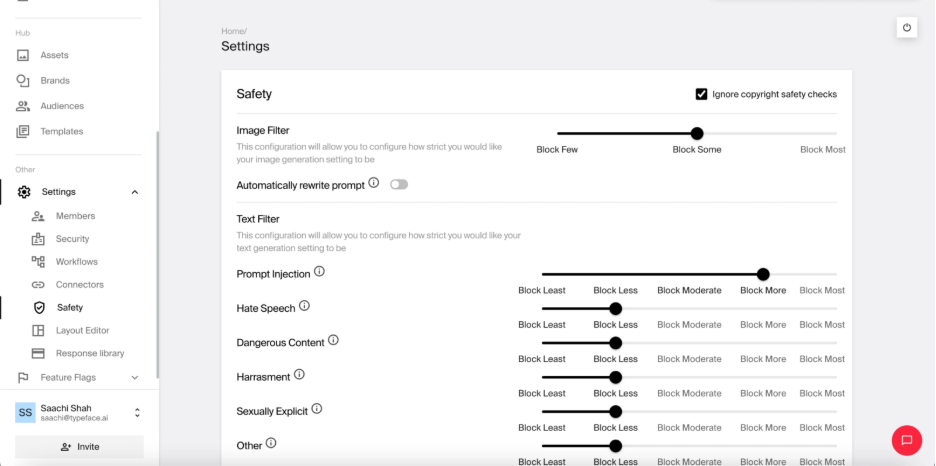
This flexible approach ensures your AI marketing operates within your unique risk tolerance and regulatory environment.
How do you maintain quality control without slowing down content production?
Short answer: Through workflow management that brings human oversight into the process at strategic checkpoints. Not for every decision, but for the ones that matter most.
Why human-in-the-loop still matters
AI excels at creating on-brand first drafts. But human judgment remains essential for:
Strategic messaging decisions
Nuanced or sensitive topics
Understanding broader business context
Adapting to market changes in real-time
Perfect brand alignment
Final quality assurance
The question isn't whether humans should be involved, but rather where in the process they add the most value.
How Typeface's Content Workflow Manager works
Our Content Workflow Manager creates structured review touchpoints where stakeholders can provide essential guidance and approval. Teams create, review, approve, and publish campaigns in one unified workflow.
By bringing stakeholders together on a single platform, it eliminates the tedious back-and-forth that typically delays campaigns and introduces errors into the final content.

Key benefits:
Customizable review stages: Create workflows that reflect your organization's specific needs. A social media post might need one approval; a white paper might need three.
Automatic routing: Content automatically goes to the right reviewers at the right time, so there’s no more "I didn't know this was waiting for me."
Clear status visibility: Everyone can see where content is in the process, who's reviewing it, and what's needed to move forward.
Integrated collaboration: Reviewers can comment, suggest edits, and approve — all in one place. No more emailing Word docs back and forth.
Performance tracking: See bottlenecks in your approval process and optimize accordingly.
What are the best practices for AI marketing governance?
While platforms like Typeface provide comprehensive quality control tools, enterprise marketing leaders need strong internal governance frameworks to maximize these capabilities.
1. Document your brand standards before you start
Many brand standards exist only in people's heads or scattered across multiple documents.
Create comprehensive brand documentation that codifies:
Visual identity standards (not just "use our logo" but "use version X in context Y with Z clearance")
Voice and tone for different contexts (executive communications vs. social media)
Messaging frameworks and key value propositions
Compliance requirements and approval thresholds
Quality standards and success metrics
2. Define clear roles and responsibilities
When "everyone is responsible," no one is accountable. Establish specific responsibilities for:
Content strategists: Define campaign objectives, audience targeting, messaging frameworks
Content creators: Generate and refine AI-assisted content
Brand managers: Ensure adherence to brand guidelines and voice
Compliance reviewers: Verify regulatory adherence and legal requirements
Approvers: Final sign-off based on role and content type
Document who reviews what content types and what they're specifically reviewing for.
3. Create feedback loops for continuous improvement
AI systems only improve if you systematically capture and apply learnings. Implement structured feedback mechanisms:
Content performance tracking:
Which AI-generated pieces performed best?
What patterns emerge in high-performing content?
Are certain brand voice settings more effective?
Team feedback capture:
What common issues do reviewers flag?
What types of content need the most revision?
Which brand guidelines cause the most confusion?
System refinement:
Update brand guidelines based on learnings
Refine audience definitions as you learn more
Adjust AI parameters to improve output quality
4. Establish graduated approval protocols
Treating all content the same creates either bottlenecks (everything needs executive approval) or risks (nothing gets proper review).
Create tiered approval requirements based on:
Content visibility: Internal vs. external, audience size
Business impact: Supporting existing campaigns vs. new market positioning
Compliance risk: Regulated claims vs. general marketing
Brand sensitivity: Using established messaging vs. new territory
Example tiers:
Low-risk content (social media posts, routine emails):
Automated brand/compliance checks
Single marketing manager approval
2-4 hour turnaround
Medium-risk content (blog posts, campaign emails, ads):
Full automated validation
Marketing manager + compliance review (if needed)
1-2 day turnaround
High-risk content (thought leadership, executive comms, new market entry):
Comprehensive automated and human review
Multi-level approval including legal and executive
3-7 day turnaround
5. Invest in team training and change management
Even the best AI tools fail if your team doesn't understand how to use them effectively.
Develop comprehensive training that covers:
How to write effective prompts
How to interpret and apply explainability insights
When to override AI suggestions vs. when to trust them
How to efficiently refine AI outputs
How to provide feedback that improves future outputs
How governance frameworks protect the brand
What metrics indicate successful AI implementation
Frequently asked questions about content quality control in AI marketing
How much does it cost to implement AI content quality controls?
Most enterprise AI marketing platforms include quality controls as part of their standard offering. The real investment is time rather than additional software costs.
The ROI typically shows up within the first quarter through faster content production and fewer brand consistency issues. Companies can save as much as 15-25 hours per week in content creation and review time after implementing comprehensive quality controls.
Can AI really maintain the same quality as human-created content?
AI excels at creating first drafts that match your established brand guidelines. Think of it as a highly trained assistant who never forgets your style guide.
However, human oversight remains essential for:
Strategic messaging decisions that require business context
Nuanced or sensitive topics that need careful judgment
Final approval and quality assurance
Adapting to new brand directions or market changes
The ideal setup combines AI efficiency (creating on-brand content at scale) with human judgment (ensuring strategic alignment).
What happens if AI generates content that violates brand guidelines?
Quality platforms, including Typeface, have multiple safety nets:
Pre-generation filtering: Blocks inappropriate prompts before content creation begins
Real-time validation: Checks content against your brand rules as it's generated
Post-generation review: Flags potential issues before content moves to approval
Human approval workflows: Requires sign-off before publication
At Typeface, the system surfaces violations and suggests fixes. You catch inconsistencies during production, and if something does slip through, check that agents had the necessary brand context to avoid repeating the errors across content.
Do you need technical skills to set up AI marketing governance?
No. Modern AI marketing platforms are designed for marketers.
You'll need:
Brand expertise: Someone who deeply understands your brand guidelines (usually a brand manager or senior marketer)
Documentation time: 2-4 weeks to document rules that might currently exist only in people's heads
Change management skills: Willingness to help your team adapt to new workflows
Iterative mindset: Comfort with testing and iterating
Technical implementation is typically point-and-click configuration.
What's the biggest mistake companies make when implementing AI content quality controls?
The biggest mistake is treating AI as a "set it and forget it" solution. Companies that struggle with AI content quality typically:
Skip the governance framework
Don't iterate based on performance
Expect immediate perfection
Remove human oversight too quickly
Teams that have successfully launched AI programs see AI as a tool that frees up time for strategic thinking and more ambitious campaigns, not as a replacement for their judgment and expertise.
Amplifying content quality control with AI
Capturing brand style consistently across content is hard enough. It shouldn't become a bigger problem when you expand AI to more channels. Get governance right and it won’t.
AI can learn your brand standards, and the more it does, the better your content gets. Embed those standards into infrastructure and your style shows up everywhere, automatically.
Typeface gives you a living brand system, with real-time checks and explainability built in to meet your quality bar. Your teams can move faster across channels and formats, knowing every output aligns with your brand.
See Typeface in action with a demo, or try a self-guided tour today.
This article is co-authored by Saachi Shah, Product Manager at Typeface.
Related articles

February 27, 2026
Most marketing teams face a common challenge: create hundreds of on-brand visuals every month without hiring more designers or blowing the budget on photoshoots. This is not without reason, of course.

April 10, 2025
We're constantly meeting with marketing leaders who’re under immense pressure to integrate AI into their strategies while delivering measurable business impact. The companies getting the most value fr

December 18, 2025
You've bought the AI tool. Your exec team is excited about the ROI projections. But three months in, adoption is stuck at 30%, and the creatives on your team are quietly finding workarounds to avoid u